
In smart cities, technical sophistication alone does not guarantee impact. Urban systems are socio-technical ecosystems involving municipalities, infrastructure operators, technology vendors, regulators, and citizens. Stakeholder engagement, therefore, must be intentional, structured, and evidence-driven. Communicating clearly about why a system exists, what it achieves, and for whom it creates value is central to alignment and trust.
In this blogpost I discuss and outline a structured approach to stakeholder engagement grounded in clarity, measurable outcomes, and credible narratives.
1. Start with the Theory of Change – What You Want to Achieve and Why?
In a smart city context, a theory of change clarifies how technological interventions translate into urban improvements. For example:
- Problem: Fragmented urban data across departments.
- Intervention: Deploy an interoperable IoT middleware.
- Mechanism: Real-time data integration and standardized APIs.
- Outcome: Faster cross-department decision-making.
- Impact: Improved service delivery and resource efficiency.
Without this explicit logic, communication becomes tool-centric (“we built a dashboard”) rather than outcome-centric (“we reduced emergency response coordination time by enabling real-time data sharing”).
For instance, if a city deploys smart traffic sensors, the theory of change should explain how sensor data leads to adaptive signal control, which reduces congestion, which in turn lowers emissions and travel time. Each link in this chain must be articulated and defensible.
Clarity at this stage prevents inflated claims and builds credibility with municipal leaders and funding agencies.
2. Pair Metrics with Meaning – Numbers Plus Context Show Real Impact
Smart city initiatives generate abundant metrics: latency, throughput, uptime, energy savings, incident detection rates. However, raw numbers rarely persuade stakeholders unless tied to operational or societal value.
Example:
- “Data processing latency reduced by 40%.”
Meaningful framing:
- “Reducing processing latency by 40% allowed traffic control operators to adjust signal timing within seconds rather than minutes, decreasing peak-hour congestion by 12% in the pilot district.”
Similarly:
- “Predictive maintenance accuracy increased by 25%” becomes
- “Improved prediction accuracy reduced unplanned streetlight outages by 18%, improving nighttime safety in residential areas.”
Stakeholders such as city managers interpret metrics through budget, risk, and service lenses. Pairing metrics with contextual implications demonstrates not only technical performance but also administrative and social relevance.
3. Focus on Outcomes – Highlight Results, Not Just Activities
Smart city projects often emphasize deployment milestones:
- 5,000 sensors installed
- New data platform launched
- Training workshops conducted
These are outputs. Stakeholders care about outcomes:
- Was congestion reduced?
- Were operational costs lowered?
- Did service equity improve across neighborhoods?
| Activity | Output | Outcome |
|---|---|---|
| Deploy air-quality sensors | Real-time pollution dashboard | Targeted traffic rerouting during high-emission events |
| Integrate building energy data | Centralized monitoring system | 10–15% reduction in municipal energy consumption |
| Implement predictive maintenance model | Anomaly detection alerts | Reduced infrastructure downtime |
Framing communication around outcomes signals maturity and impact orientation rather than technical enthusiasm.
4. Use Storytelling as Evidence – Let Stories Illustrate Your Impact
In complex urban systems, stakeholders benefit from concrete narratives illustrating how technology functions under real conditions.
Example scenario:
During a winter storm, road-condition sensors detected abnormal freezing patterns. The system automatically alerted municipal maintenance teams and optimised salt distribution routes. Response time decreased from 45 minutes to 20 minutes compared to previous storms, reducing accident reports in affected zones.
This narrative:
- Demonstrates the mechanism (detection + routing optimisation)
- Connects technical performance to public safety
- Provides contextual evidence beyond abstract metrics
Stories should always be backed by verifiable data. Their purpose is to illustrate causal pathways and make impact tangible.
5. Communicating Across Smart City Stakeholders
Smart city ecosystems involve heterogeneous actors with distinct priorities:
- Municipal executives: Cost efficiency, political accountability, service delivery.
- Technical operators: Reliability, interoperability, maintainability.
- Citizens: Privacy, transparency, equity.
- Regulators: Compliance, data governance, security.
Effective engagement requires translating the same intervention into stakeholder-relevant language. For example:
- To executives: emphasize budget savings and risk reduction.
- To engineers: emphasize system architecture and performance benchmarks.
- To citizens: emphasize privacy-by-design and equitable service access.
Alignment emerges when stakeholders see their interests reflected in the communication.
6. Stakeholders Categorisation
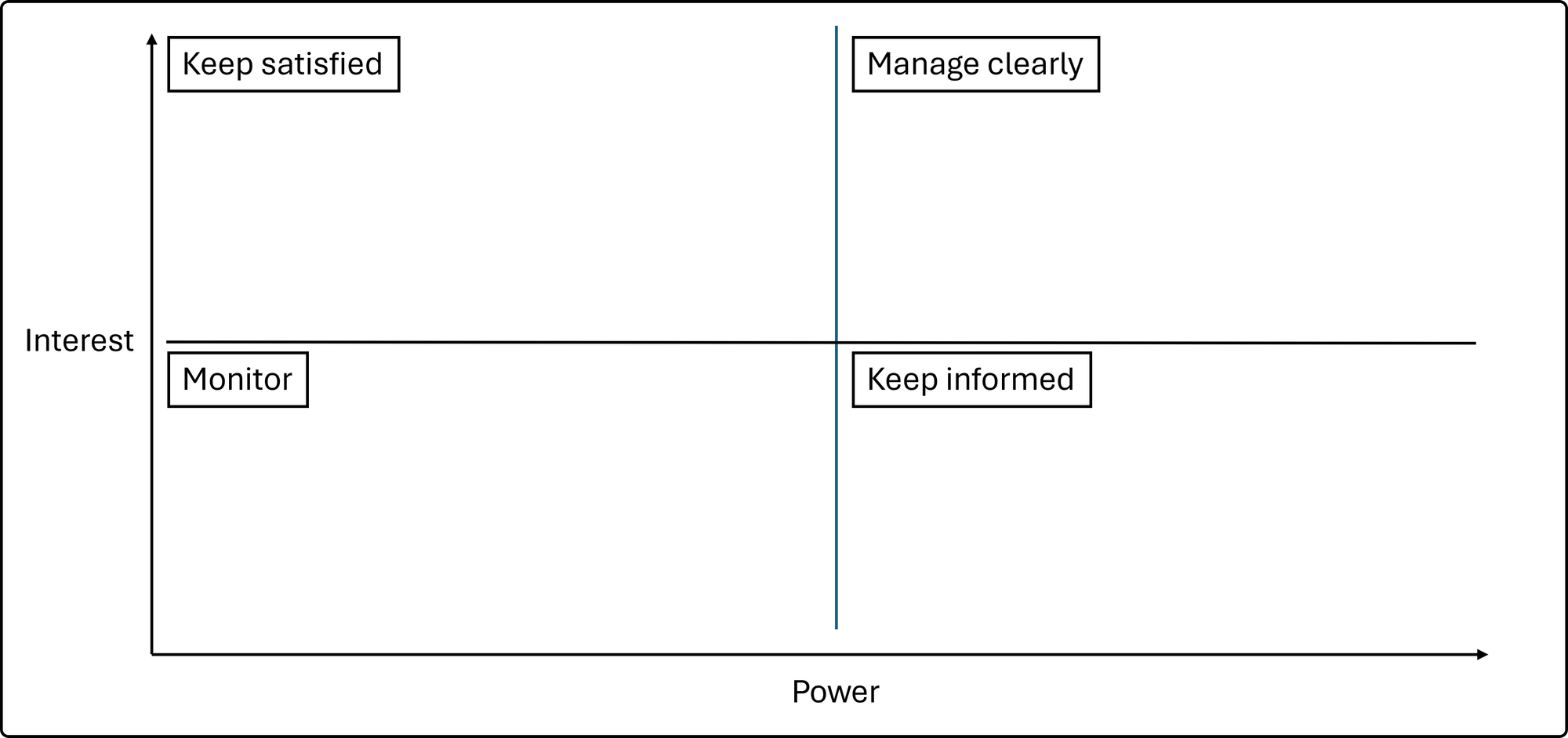
Stakeholders can be organized using a power–interest matrix, where the x-axis represents the level of power (ability to influence decisions or outcomes) and the y-axis represents the level of interest (degree of concern or involvement in the project). This framework helps prioritiwe engagement strategies rather than treating all stakeholders uniformly.
Stakeholders with high power and high interest (top-right quadrant) must be closely managed. They directly shape funding decisions, technical direction, and governance structures. For example, in a research project developing an urban data platform, municipal CIOs or funding agencies fall into this category. They can approve budgets, halt deployment, or redefine scope; therefore, they require continuous communication, performance evidence, and alignment on objectives.
Similarly, stakeholders with low power and low interest (bottom-left quadrant) require monitoring. They may include peripheral actors or potential competitors. While they do not demand intensive engagement, ignoring them entirely can be risky, especially if contextual changes increase their influence.
Using this matrix ensures that engagement intensity matches stakeholder influence. It transforms stakeholder management from ad hoc communication into a structured strategic practice.
7. Key Takeaways
- Start with the theory of change – what you want to achieve and why?
- Pair metrics with meaning – numbers plus context show real impact
- Focus on outcomes – highlight results, not just activities
- Use storytelling as evidence – let stories illustrate your impact
8. Final Reflection
In smart cities, technology operates within political, institutional, and social constraints. Stakeholder engagement is therefore not an optional communication layer; it is a strategic function that determines adoption and long-term sustainability.
If you:
- Start with a clear theory of change
- Pair technical metrics with urban meaning
- Communicate outcomes rather than activities
- Use evidence-based storytelling
you move from reporting innovation to demonstrating impact. In complex urban environments, that distinction is decisive.
